Holedo is the world’s most advanced recruiting platform.
Holedo doesn’t sell the pain. It ends it.
Hiring is hard. That’s why the market is flooded with products that monetise the pain.
Every industry has a talent pool. But job boards, LinkedIn, and social media own the gate.
You pay to search. You pay to contact. You keep paying to reach what already belongs to you.
Why do companies keep paying over and over again?
They pay to search. They pay to connect.
They pay to reach what already belongs to them.
Applicant Tracking Systems (ATS) aren’t talent pools. They’re archives.
Job boards and networks aren’t talent pools. Holedo is.
With Holedo, hiring stops being pay-per-view.
Companies own their talent pool.
LinkedIn monetises isolation.
Each employer sees only what they pay for.
Each candidate performs for visibility.
There’s no shared pool.
It’s not built for trust. It’s built for churn.
Holedo fixes that.
We’re not fixing hiring for one company. We’re fixing how industries hire, globally.
The Data Advantage — Holedo’s Moat
Holedo gets smarter with every use.
Every connection compounds value.
Every employer strengthens the network.
Each action enriches a live dataset of global hiring behavior — an asset no other HR platform can replicate.
Every interaction adds intelligence.
Legacy HR tech stalls. Holedo compounds value — clean architecture, no debt, no drag.
This isn’t another SaaS tool.
It’s data infrastructure for global hiring.
This is the moat.
Competitors sell tools. Holedo owns the network that makes them obsolete.
This dataset becomes the intelligence layer for global hiring —
turning Holedo’s data moat into the foundation for AI-driven workforce intelligence worldwide.
AI becomes exponentially more valuable on top of Holedo’s data — because it’s clean, connected, and cross-company.
Hiring keeps resetting. And the platforms keep charging.
Every job post starts from zero.
Every lost employee means paying again to rebuild the pipeline.
Holedo changes this.
Talent flows and remains connected:
- Every person they’ve engaged
- Every connection they’ve built
- Every hire waiting to happen
If a company has an ATS, Holedo collects the talent pool in front of it.
If they don’t, Holedo puts the talent pool in their pocket.
If they outgrow their ATS, Holedo replaces it entirely.
With Holedo, companies stop paying to reach the same people.
They own their talent pool.
Holedo is not a marketplace. It’s infrastructure.
It holds relationships across searches, time zones, and teams.
It preserves history. It enables flow.
This changes everything:
- Employers stop chasing
- Talent stays connected
- The loop closes
- Each search enriches the dataset. Every hire strengthens the network.
You don’t own talent, but you can hold it, grow it, and keep the connection.
That’s the shift.
That’s what Holedo delivers.
HR-tech's job is to make employers pay.
For decades, hiring meant paying to keep trying.
More job posts. More filters. More fees.
It doesn’t have to work like that.
Holedo stops the cycle.
You own your talent pool. Hiring compounds instead of resetting.
AI doesn’t fix hiring. It fixes search.
AI filters, but it doesn’t create talent.
- It scans résumés, but it doesn’t build relationships.
- It sorts faster, but it doesn’t grow a talent pool.
- It automates tasks, but it doesn’t fix retention.
Hiring doesn’t break because filters are slow.
It breaks because the talent supply keeps resetting.
AI-powered hiring without the gimmicks.
Holedo doesn’t sell AI. We use it to make hiring effortless.
- Search in plain English.
“Find me a front office manager with 5+ years in luxury hotels.” - Predict hiring trends.
See movement before it happens. - Smarter search. Faster hiring.
No gimmicks. No guesswork. Just results.
Private testing now. Rollout next.

Watch why Holedo makes hiring effortless.
Hotels pay for churn twice.
Once for the cost of turnover.
And again to re-access their own talent.
The numbers don’t lie
| Hotel category | Average staff per hotel | Turnover rate | Employees lost per year | Cost per employee | Total annual loss |
|---|---|---|---|---|---|
| 5-Star Hotels | ~250 | 55% | 2.67M | $15,000 | $40B |
| 4-Star Hotels | ~150 | 65% | 8.86M | $10,000 | $89B |
| 3-Star Hotels | ~75 | 75% | 13.98M | $7,500 | $104B |
| Total Impact | 25.51M employees lost per year | $233B per year |
See full methodology and sources → Hospitality Turnover Costs – Data & Sources
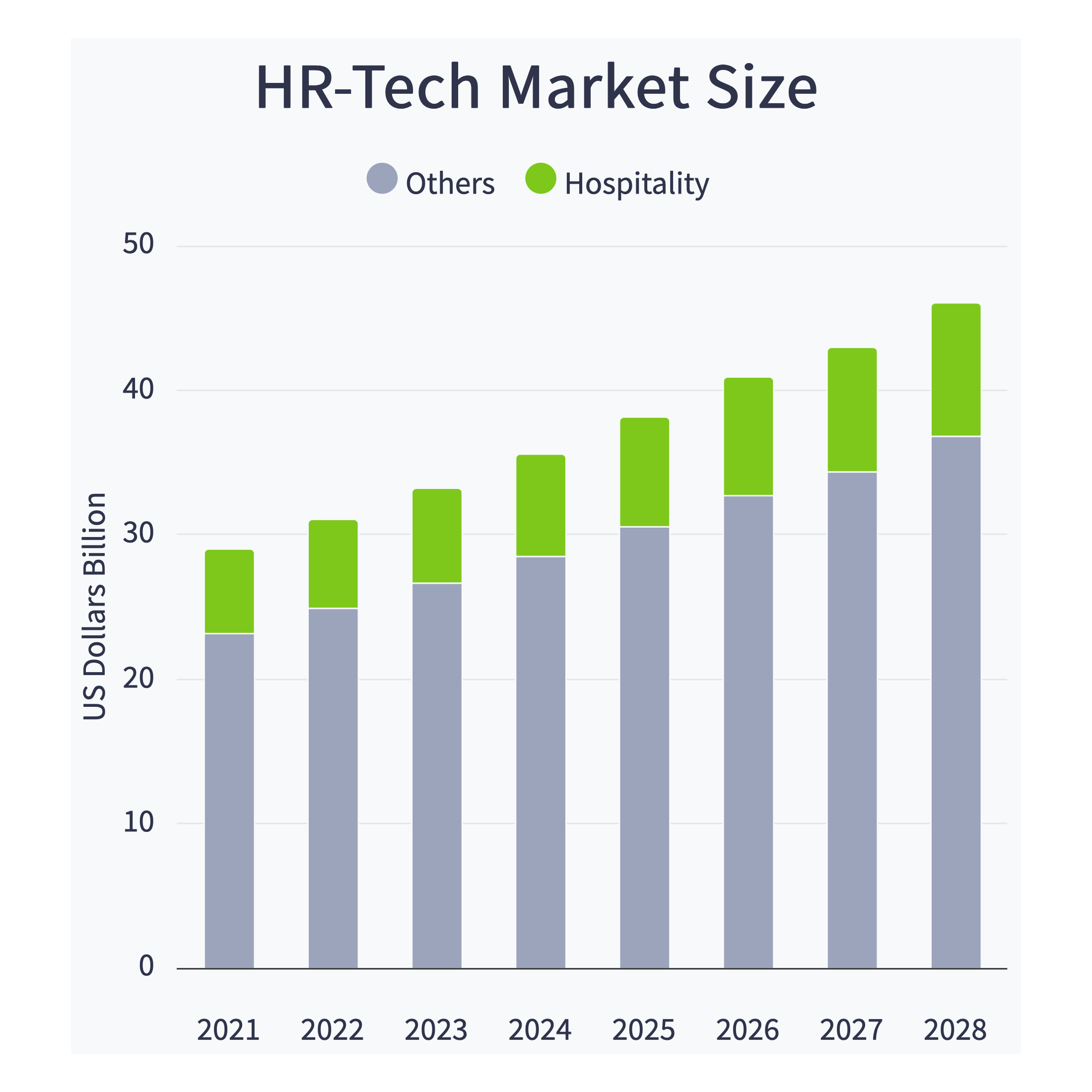
The $48 Billion Market — and Growing
HR tech is a $48 billion market, projected to reach $60 billion by 2028.
Hospitality alone loses $2.23 trillion annually in rehiring and training costs.
Staffing is the biggest challenge in hospitality.
Hiring is broken.
The market demands a fix.
Holedo operates in a sector of over 300,000 star-rated hotels worldwide.
Market Validation
Holedo is live, scaling, and onboarding across four continents.
Hotels are joining, and the pipeline keeps growing.
- Active pilots: Indonesia, Colombia, Portugal
- New signups: North America, Latin America, Asia, Europe
- Every new client: Strengthens the shared pool
- 20+ properties live, 2,000+ users connected globally
Holedo is already rolling out with hotel groups across Asia, the Middle East, and Europe,
including one group operating over 30 luxury properties.
Each new account deepens the shared network and accelerates adoption.
The traction is real, global, and expanding without marketing spend.
The bottleneck isn’t demand.
It’s time and people.
Automation removes both limits.
Live Pilot — Indonesia
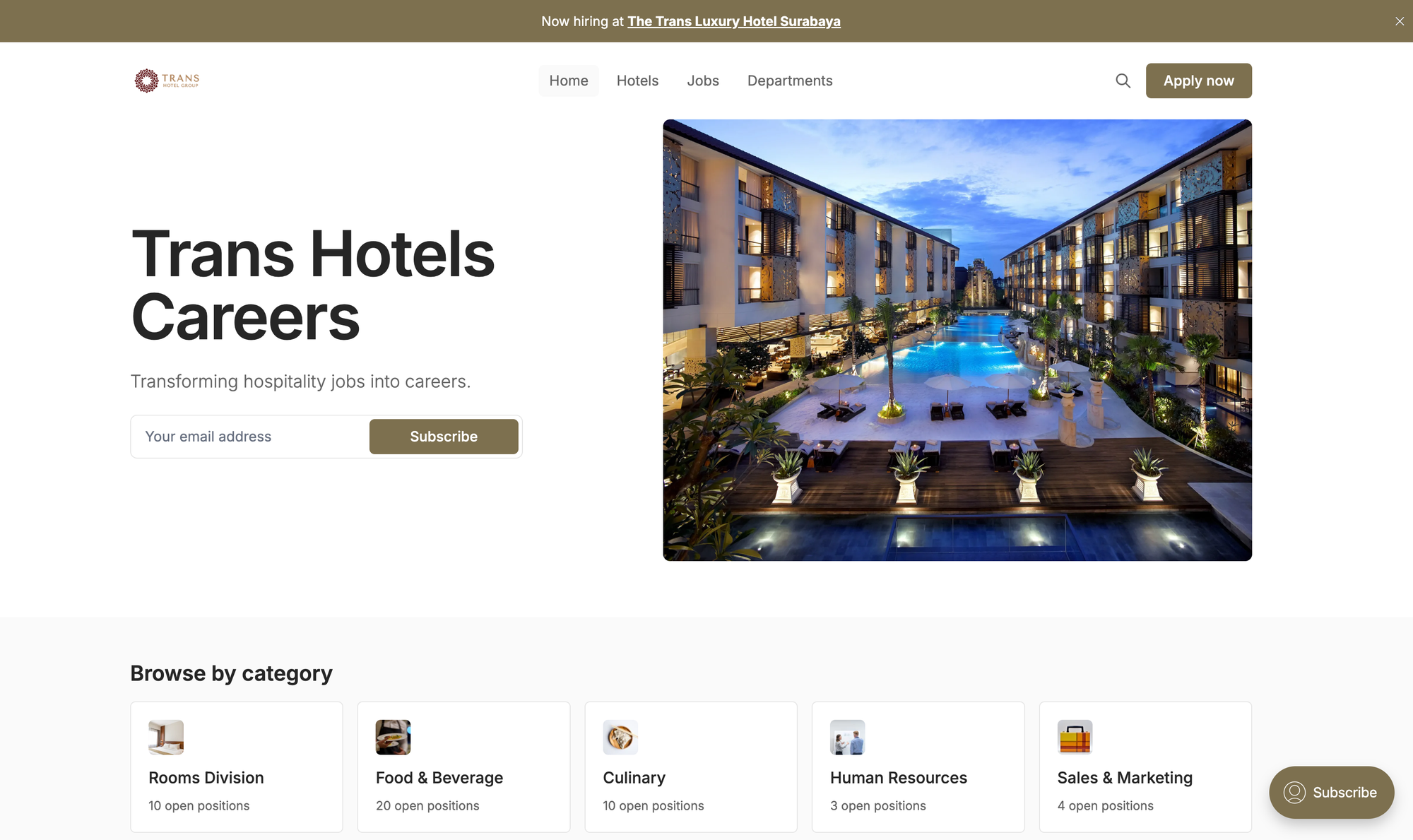
Live portal: transhotels.hospitality.careers
Powered by Holedo.
Runs across multiple properties in Indonesia.
Demonstrates one of several API delivery methods — the platform connects directly to Ghost for instant, branded deployment.
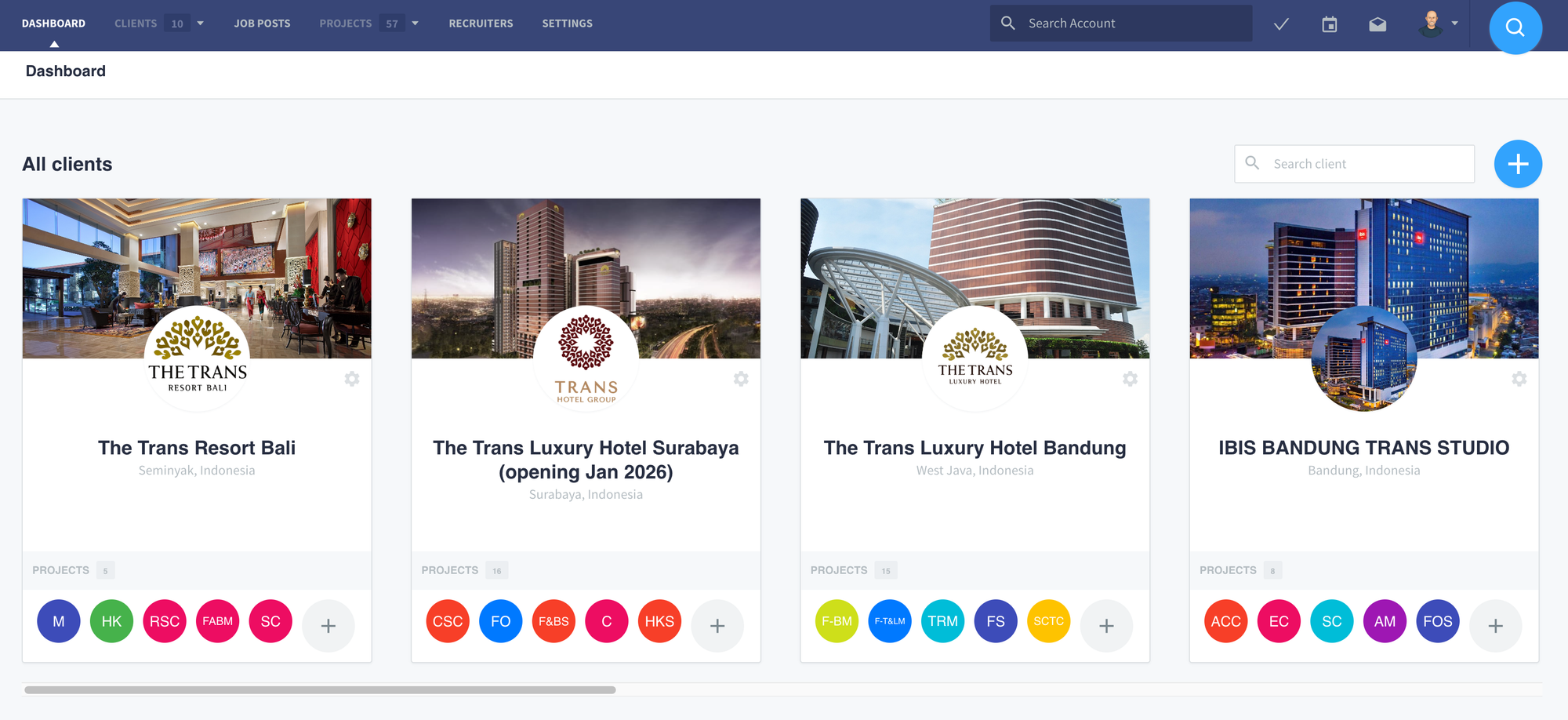
Holedo Hiring Dashboard:
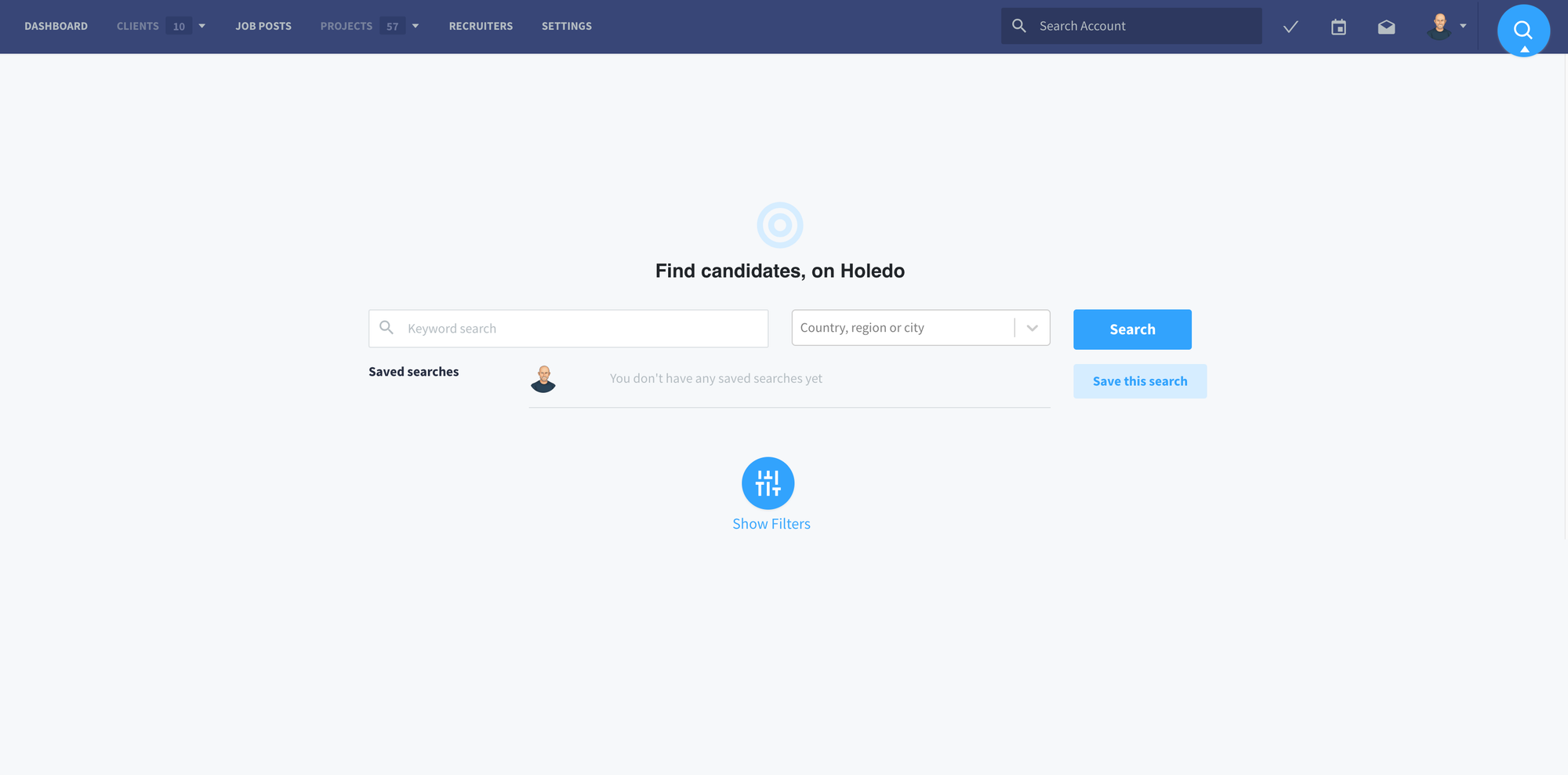
Holedo Talent Pool Search:
Why Investors Win
Holedo isn’t an idea. It’s running, proven, and scaling.
The next 12 months focus on automating what already works.
The value grows with every new user.
Each employer, each hire, and each profile strengthens the network.
That data is the moat.
That’s what investors own.
“Every search, every hire, every connection adds intelligence.
That’s not software growth — that’s dataset compounding.”
— Holedo Investor Summary
Nobody Can Build This
HR Tech giants are trapped.
They can’t move. They built a prison and locked themselves in.
- €500/month kills their model. They need enterprise pricing to survive.
- They have no shared talent pool. Every product is a silo.
- They can’t pivot. Their tech is bloated, tangled, and outdated.
- They can’t match frictionless adoption. Holedo runs instantly.
Even if they copied Holedo tomorrow, it wouldn’t matter.
- Network effects. Every employer makes Holedo stronger.
- Industry-wide intelligence. They stop at company walls.
- Plug-and-play hiring. Holedo runs out of the box.
For them to compete, they’d have to kill their own revenue stream.
They won’t.
From Consultancy to Infrastructure
Holedo was built inside Hospitality.Haus, an executive search and consulting firm serving leading hotel groups worldwide.
The team created Holedo to solve the hiring problems they kept fixing manually — and it worked.
The platform’s development is powered by LimaBean.Agency, a leading digital agency and co-founding partner.
They provide development resources at cost and often allocate spare capacity free of charge.
This partnership keeps Holedo’s tech expenses low while maintaining full in-house control of the codebase.
With the product proven and adoption growing across continents, the next step is clear:
transition the founders from Hospitality.Haus to Holedo full-time.
This round enables that shift — giving Holedo full-time leadership, focused execution, and the capacity to scale.
Built to Scale — API-First and Future-Proof
Holedo is fully API-driven and built on the same secure communication backbone trusted by NATO, the UN, and multiple national governments.
It has no legacy code, no tech debt, and no integration friction.
Every component connects through clean APIs, enabling instant automation and seamless scalability.
Legacy HR systems can’t compete. Their infrastructure depends on siloed databases and enterprise pricing.
Rebuilding from scratch would destroy their business model.
Holedo scales where they can’t move — lean, fast, and built for constant evolution.
Hotels log in, activate instantly, and start hiring.
No setup. No onboarding. No IT dependencies.
That’s why every new client expands the network and strengthens the data asset.
The platform replaces fragmented HR systems — ATSs, CRMs, job boards, and project tools — with one unified system that works out of the box.
Fast, stable, and secure.
Holedo’s technical backbone is powered by LimaBean.Agency, a co-founding partner providing world-class development at cost.
Their team supports ongoing delivery with proven capacity and reliability, giving Holedo deep technical leverage without enterprise overhead.
Tech Moves Fast. Holedo Moves Faster.
- API-first. Everything connects, extends, and scales.
- AI-ready—without bloat. Intelligence built-in, not bolted on.
- No constraints. No friction. No limits.
Plug in. Automate. Scale.
Workflows connect. Systems extend. Nothing slows down.
No outdated infrastructure.
No rebuilds. No drag. Just speed.
Future-proof from day one.
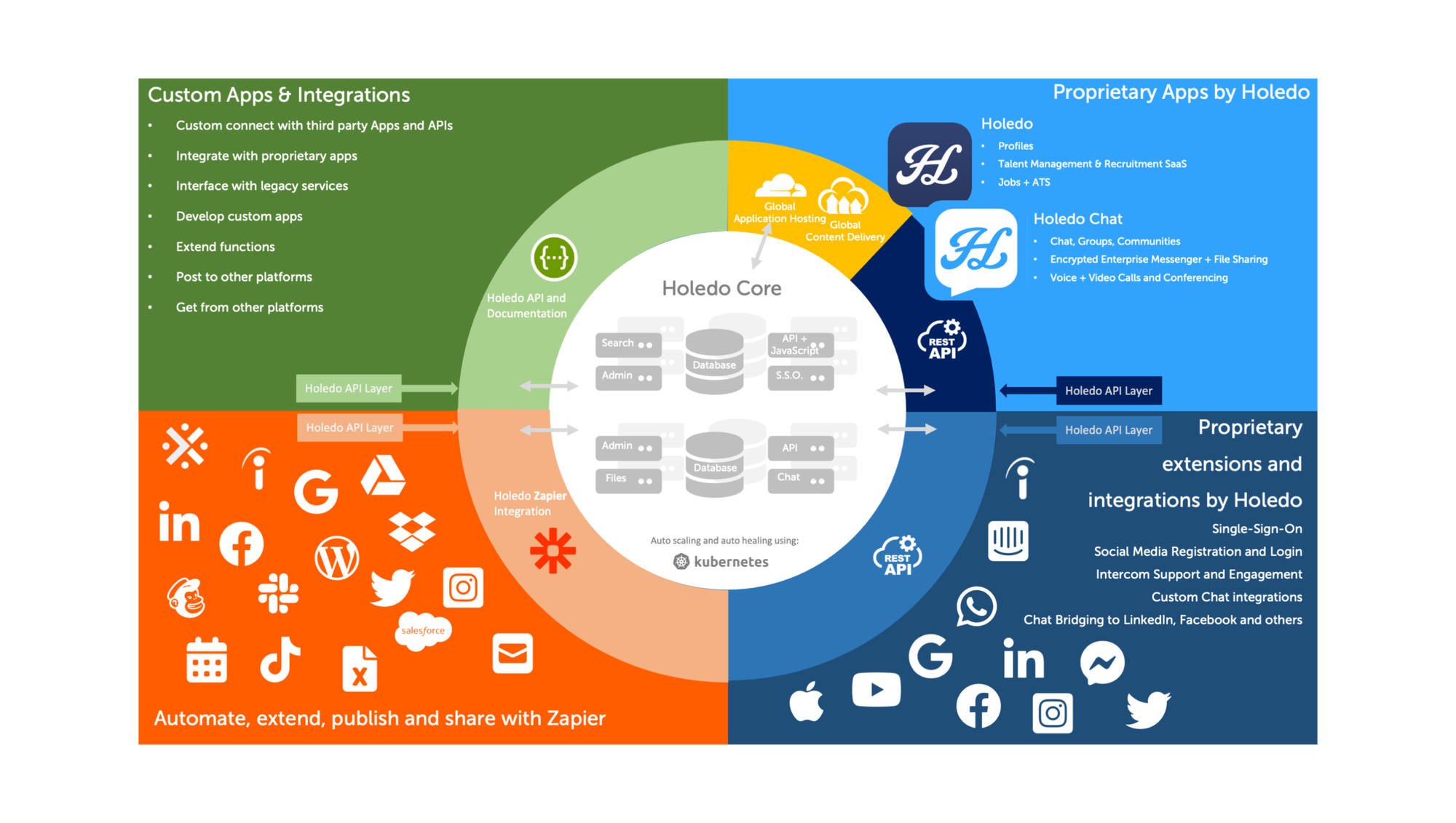
Holedo Works Like an Appliance
No setup. No manuals. No downtime.
Log in. Upload your logo. Start hiring.
You don’t read a manual for a toaster.
You don’t need training for a microwave.
Holedo delivers the same simplicity — enterprise power with consumer ease.
That’s why adoption happens instantly.
No onboarding friction. No sales calls. No IT roadblocks.
That’s why adoption scales on its own — one company activates, the next follows.
Lean by Design — Adoption First
Holedo runs lean.
Core costs are about €1,000/month.
Founders work part-time without pay and cover all costs directly.
This round funds full-time focus, not survival.
- Core burn: €1,000/month (hosting and tools)
- Founders: Part-time, unpaid
- Next step: Automate onboarding and scale globally
We’ve built the product.
Now we scale it.
Holedo’s strategy mirrors how category-defining platforms grow.
LinkedIn, Zoom, and Notion built usage before monetisation because network effects create defensibility.
Every new user strengthens the shared dataset and compounds value for all.
Once automation removes onboarding friction, adoption accelerates organically.
Freemium access builds volume.
Business and enterprise tiers convert usage into revenue.
The network is the product. Revenue follows growth.
See pricing and tiers → employers.holedo.com/pricing
Invest in Holedo
We’re raising €250,000 in Convertible Notes to automate onboarding and scale globally.
- Valuation Cap: €2.5M
- Discount: 20%
- Interest: 5% per year
Use of Funds
This round funds 12 months of full-time execution and automation.
- Founder Salaries (12 months): €120,000
- Development Resources: €100,000
- Running Costs (hosting, tools, services): €30,000
Total: €250,000
Holedo is already live and scaling across four continents.
The only limit is capacity.
This round removes that limit and turns manual growth into automated scale.
Execution at full speed.
Investors aren’t buying future promises — they’re buying a working system with compounding data value.
Talent Moves Like Supply Chains. Hiring Is Stuck in the 90s.
Zara doesn’t wait for trends — it tracks demand in real time:
- Demand shifts? It adjusts.
- New styles? It delivers.
- Supply flows without friction.
Hiring should work the same way.
It doesn’t — because hiring never worked as a supply chain.
- No live talent supply. Employers chase, but talent isn’t connected.
- No real-time data. Hiring stumbles on outdated profiles.
- No continuous flow. Every hire restarts the process.
Hiring stays slow, expensive, disconnected.
Because companies never owned the system.
Holedo combines supply chain thinking with recruitment. It’s placement at scale.

Holedo makes hiring industry-owned.
The Network Effect
Every hotel that joins Holedo makes hiring easier for the next.
Each search enriches the dataset. Each connection strengthens the network.
Recruitment stops being one-off.
It becomes continuous, connected, and compounding.
- Every company that searches adds value for all.
- Talent stays visible—active, flowing, connected.
- Hiring moves like a supply chain—not a reset.
Holedo isn’t another tool.
It’s the industry’s missing infrastructure.

The Data Is the Asset
Every hiring action, every connection, every movement adds intelligence.
Across employers, industries, and regions — Holedo sees how talent flows.
This is more than analytics. It’s live hiring intelligence.
Over time, it becomes the global dataset of how industries hire, move, and grow.
That’s what no other platform has.
Not Notion. Not Figma. Not LinkedIn.
Others build communities.
Holedo builds the dataset that powers an industry.
That’s the asset investors own.
Revenue is the side effect.
Beyond Hospitality
Our sister brand, PAX.careers, expands the same system into
Healthcare, Aviation, and Retail.
Hospitality is the launch industry.
The infrastructure scales horizontally into every service-driven sector.
This Isn’t a Pitch. It’s Happening.
The infrastructure is built. The data is flowing.
Now it’s time to own the system that powers global hiring.
Holedo isn’t changing how companies hire — it’s changing who owns hiring.